Almost every foreign visitor to Kyoto sees temples and shrines, but few try a cultural experience. In Kyoto City’s 2025 survey of foreign visitors, 22.6% made Japanese sweets or other food, and 17.2% experienced geiko and maiko culture. Only 14.7% tried tea ceremony, flower arranging or calligraphy, and 12.5% wore a kimono or yukata. If you book one, you’re already doing something most visitors miss.
| Experience | Share of foreign visitors who did it (2025) | Best for |
|---|---|---|
| Making Japanese sweets or food | 22.6% | Hands-on fun, families |
| Geiko and maiko culture | 17.2% | Seeing Kyoto’s own tradition up close |
| Tea ceremony, flowers, calligraphy | 14.7% | A quiet, focused hour |
| Kimono or yukata | 12.5% | Photos around town |
| Noh, kyogen or kabuki | 9.7% | Watching traditional theater |
| Crafts such as pottery | 5.4% | Taking home something you made |
- What visitors actually do in Kyoto
- The main kinds of cultural experience
- How to choose
What visitors actually do in Kyoto
Kyoto City surveys foreign visitors every year. In the 2025 survey, published in June 2026, 1,729 visitors said what they did in the city. The results haven’t been published in English, so we translated the main ones.
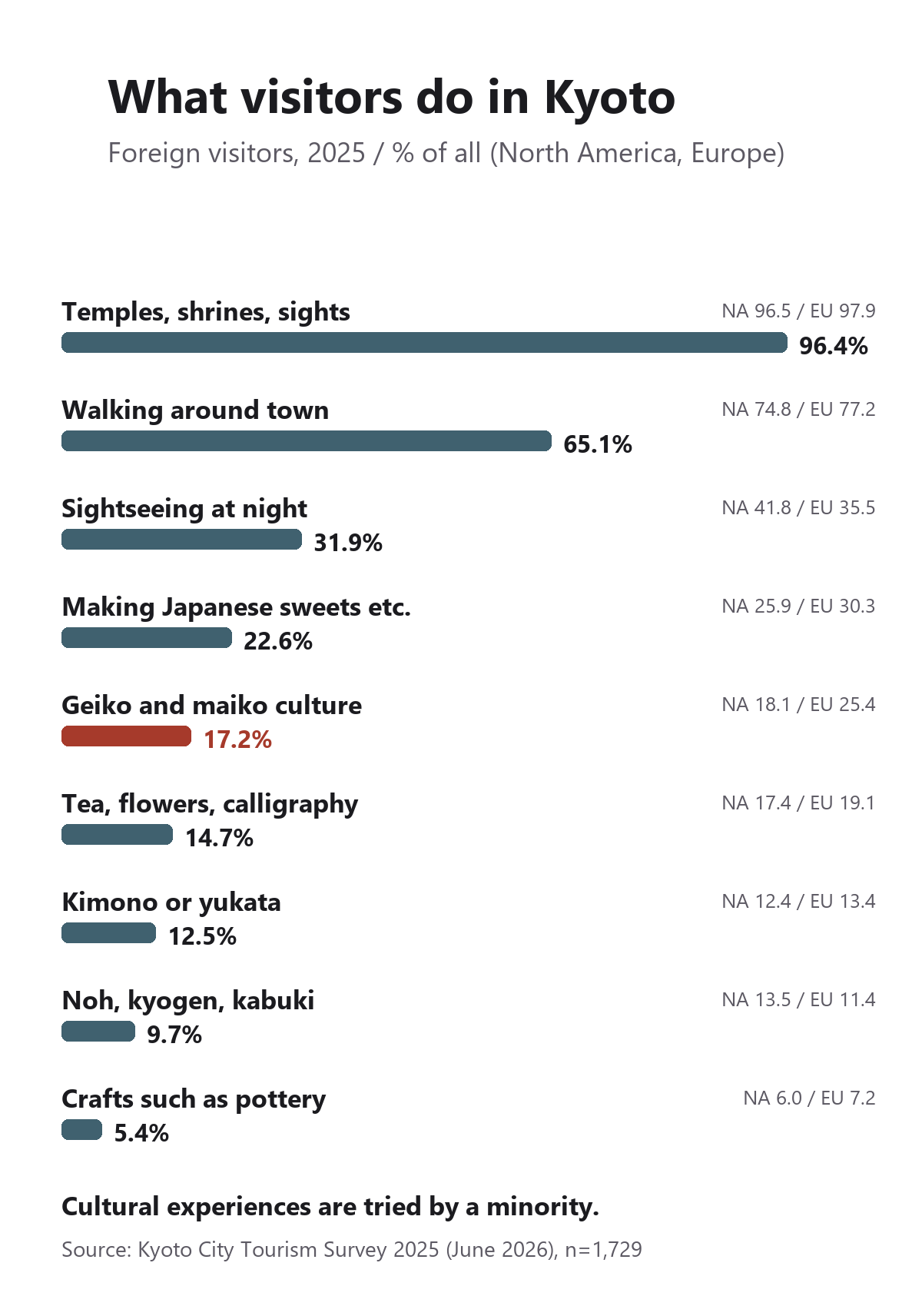
Two things stand out. First, every cultural experience on the list was tried by fewer than one in four visitors. Second, visitors from Europe tried every one of them more often than the average. Among Europeans, one in four experienced geiko and maiko culture.
The main kinds of cultural experience
Making Japanese sweets or food
The most popular hands-on experience in the survey. You make Japanese sweets (wagashi) or other dishes with a teacher, then eat what you made. It’s indoors, so it works on a rainy day.
Meeting a maiko
A maiko is an apprentice geiko, Kyoto’s word for geisha. You can watch maiko dance at the spring odori or at Gion Corner, but to talk with one, you need a small-group experience or a teahouse introduction.
Our 90-minute experience takes place in a temple space usually closed to visitors, with about 10 guests. A maiko dances, plays traditional party games with you and joins you for photos. She speaks Japanese, and a native English-speaking host interprets. It costs from ¥31,000 per person. Our guide to the geisha experience in Kyoto explains it in detail.
A maiko dances, plays traditional games with you and answers your questions, with English interpretation. Groups are about 10 guests.
Tea ceremony, flower arranging and calligraphy
A tea ceremony is a set way of making and serving matcha. You can join one at a tea house, or have tea at a geisha dance. At the spring odori, some tickets include a tea seat, and at the Kyo Odori a geiko makes the tea. Gion Corner also sells a seat with a tea ceremony for ¥6,050. Our guide to the geisha tea ceremony in Kyoto compares these.
Kimono or yukata
You rent a kimono, or a light cotton yukata in summer, and walk around town in it. It’s mainly about the photos. Wearing a kimono is not the same as a maiko makeover, where a studio dresses you up as a maiko; in neither case do you meet a real maiko.
Traditional theater
Noh, kyogen and kabuki are the classic stage arts. If you want a short sampler, Gion Corner shows seven traditional arts in about an hour, including kyogen comedy, court dance (bugaku) and a maiko’s dance, for ¥5,500. Our guide to geisha shows in Kyoto lists the dates of the spring dances.
Pottery and other crafts
The least common experience in the survey, at 5.4%. You make a cup or bowl with a potter’s help. A piece usually has to be fired after you make it, so ask how and when you’ll receive it.
How to choose
| If you… | Try |
|---|---|
| Have one hour in Gion | Gion Corner (about an hour, ¥5,500) |
| Want to meet someone, not just watch | A small-group maiko experience |
| Travel with young children | Sweets-making. For our maiko experience, children depend on the plan and venue, so tell us their ages when you book. The Kyo Odori doesn’t admit children under 10. |
| Want something for a rainy day | Any indoor experience: sweets-making, tea, a maiko experience or a theater show |
| Visit in winter | See our guide to things to do in Kyoto in winter |
Show answer
Frequently asked questions
What is a unique experience in Kyoto?
Meeting a maiko is the one experience that belongs to Kyoto: the word “maiko” is used only in Kyoto. In 2025, 17.2% of foreign visitors experienced geiko and maiko culture.
What cultural experiences can you do in Kyoto?
Making Japanese sweets, meeting a maiko, tea ceremony, flower arranging, calligraphy, wearing a kimono, watching noh or kabuki, and making pottery are the main ones.
Which Kyoto experience is the most popular?
In Kyoto City’s 2025 survey, making Japanese sweets or food was the most common hands-on experience among foreign visitors, at 22.6%.
How many experiences should I book?
That depends on your time. Check how long each one takes: Gion Corner is about an hour, and our maiko experience is about 90 minutes.
A maiko dances, plays ozashiki games with you and joins you for photos, in a temple space usually closed to visitors.