Winter is Kyoto’s quietest season. In 2025, February had the fewest foreign overnight stays of any month, less than half of April’s. It is also a busy time in the geisha districts, with year-end greetings, New Year ceremonies and Setsubun in early February. Only a few of these events are open to visitors, though. This guide lists them month by month, with dates and prices from the official Japanese sources, and gives ideas for cold or rainy days.
In Kyoto, geisha are called geiko. Maiko are apprentice geiko.
| Month | What you can see | What isn’t a public event |
|---|---|---|
| December | Kencha-sai tea at Kitano Tenmangu (Dec 1, ticket); Gokagai no Utage lunch with a dance show (Dec 19, ticket) | Kotohajime (Dec 13), Okotosan (Dec 31) |
| January | Miyako Odori tickets go on sale (Jan 6, 2027) | Shigyoshiki (Jan 7 and 9), Hatsuyori (Jan 13) |
| February | Setsubun dance offerings at Yasaka Shrine and Kitano Tenmangu; Baikasai open-air tea (Feb 25, ticket) | Obake on Setsubun night |
If you’d rather not plan around a few dates, check our 90-minute maiko experience for the days you’re in Kyoto.
- Why winter is a good time to visit Kyoto
- December: tea, a dance lunch and the year-end greetings
- January: the geisha districts’ New Year
- February: Setsubun and the plum-blossom tea
- Cold or rainy day? Indoor ways to see a maiko
- Please don’t follow maiko in the street
- Before you book: price, time, clothes and children
Why winter is a good time to visit Kyoto
Kyoto City counts the overnight stays of foreign visitors every month. In 2025, the three lowest months were February, January and December. February had 892,285 stays. April, cherry blossom season, had 1,966,136.
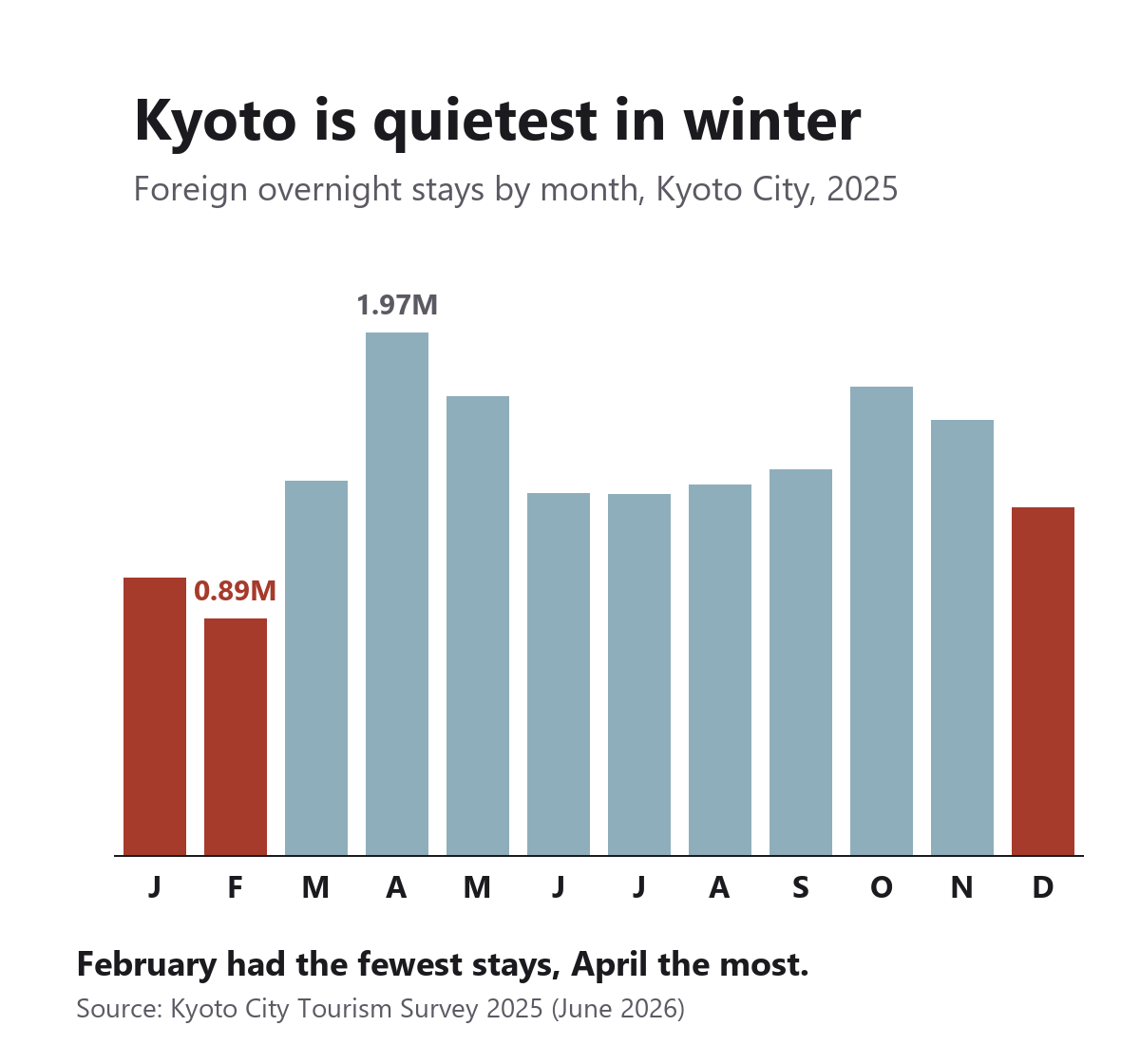
Crowds are what visitors complain about most. In the same survey, 21.0% of foreign visitors said something about their trip had disappointed them, and “too many people” was the top reason. In winter, popular places are easier to enjoy, and dates for experiences are easier to get.
December: tea, a dance lunch and the year-end greetings
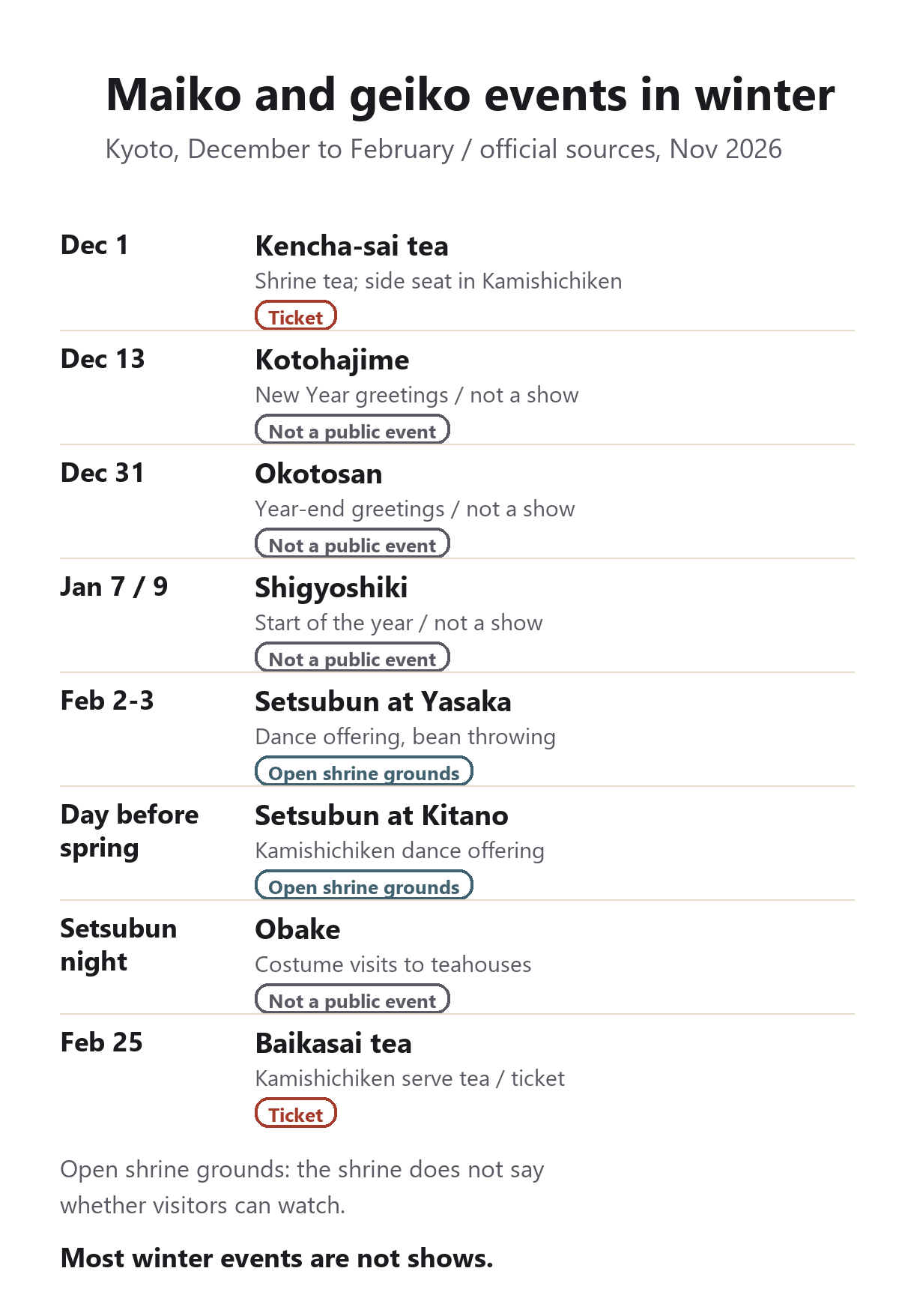
Kencha-sai, Kitano Tenmangu (December 1). A tea offering held every year in the shrine’s main hall. On the same day, a side tea room opens at the Kamishichiken Kaburenjo theater, where geiko perform the tea ceremony and maiko carry the tea. For 2026, the shrine sells a ticket set for ¥10,000 from November 1 at its Bundo Kaikan hall, with no mail orders. The shrine’s notice doesn’t say which tea rooms the ticket covers, so ask at the shrine before you buy.
Gokagai no Utage (December 19, 2026). A lunch event run by the Ookini Foundation, which supports Kyoto’s five geisha districts. It runs from 12:30 to 14:30 at a hotel connected to Kyoto Station, with a dance show by geiko and maiko, a talk, lunch and free drinks. Tickets are ¥25,000, there are 200 seats, and online booking closes on December 4. There’s a dress code: no jeans or sneakers, and men wear a suit or jacket. The booking page is in Japanese.
Kotohajime (December 13). The day geiko and maiko visit their teachers and teahouses to thank them for the year and ask for their support in the next. It isn’t a show. The Ookini Foundation asks people not to take photos on public streets during these greetings.
Okotosan (December 31). On New Year’s Eve, geiko and maiko in Gion Kobu, Miyagawacho and Gion Higashi go round the teahouses with year-end greetings. The teahouses give the maiko fukudama, small balls with little gifts inside. Kyoto City notes that you see maiko carrying them less often now, because more maiko come from outside Kyoto and go home for the holidays.
January: the geisha districts’ New Year
Shigyoshiki (January 7; Kamishichiken, January 9). The opening ceremony of the geisha year in each district. In Miyagawacho, it is held only for the people of the district. Like Kotohajime, it isn’t a show, and the Ookini Foundation asks people not to take photos on public streets.
Hatsuyori (January 13, Gion Kobu). Geiko and maiko gather at their teacher’s home to greet the new year and promise to work hard at their lessons.
Miyako Odori tickets (January 6, 2027). Gion Kobu’s spring dance runs April 1–30, 2027, with three shows a day. Tickets go on sale at 10:00 on January 6. The best seat, with tea, costs ¥8,000. If you’re coming back in spring, January is when to book. Our guide to the best geisha shows in Kyoto compares all five spring dances.
▶
◀
▶
◀
February: Setsubun and the plum-blossom tea
Setsubun at Yasaka Shrine (February 2–3). Geiko and maiko from four districts (Gion Kobu, Miyagawacho, Pontocho and Gion Higashi) perform dances on the stage in the shrine grounds, and beans are thrown to drive out bad luck. The shrine lists the dates as February 2 and 3. They can move with the date of Setsubun: in 2025, the events began on February 1. The shrine’s page doesn’t say whether visitors can watch, so check the shrine’s notice for the year.
Setsubun at Kitano Tenmangu (the day before spring begins). After the Setsubun rite, there is a kyogen comic play on the shrine’s dance stage, then a dance by Kamishichiken’s geiko and maiko, then bean throwing. The shrine gives the day, not the time.
Obake (Setsubun night). On the evening of Setsubun, geiko and maiko dress up in costumes and visit teahouses. According to the Ookini Foundation, the custom comes from an old trick for slipping past demons on Setsubun night: older women copied young girls’ hairstyles, and young girls dressed their hair like grown women. Kyoto City calls it a townspeople’s custom to ward off bad luck. It happens inside the teahouses and isn’t a public event.
Baikasai open-air tea, Kitano Tenmangu (February 25). Geiko and maiko from Kamishichiken serve tea outdoors among the shrine’s plum trees. The tea has been held since 1952. In 2025, it ran from 10:00 to 15:00, rain or shine, for ¥3,000 per person, and tickets were sold only at the shrine on the day. For more ways to have tea with geiko, see our geisha tea ceremony guide.
Show answer
Cold or rainy day? Indoor ways to see a maiko
Most of the events above are outdoors, held on a single day, or not open to visitors at all. On a cold or rainy day, these are the indoor options.
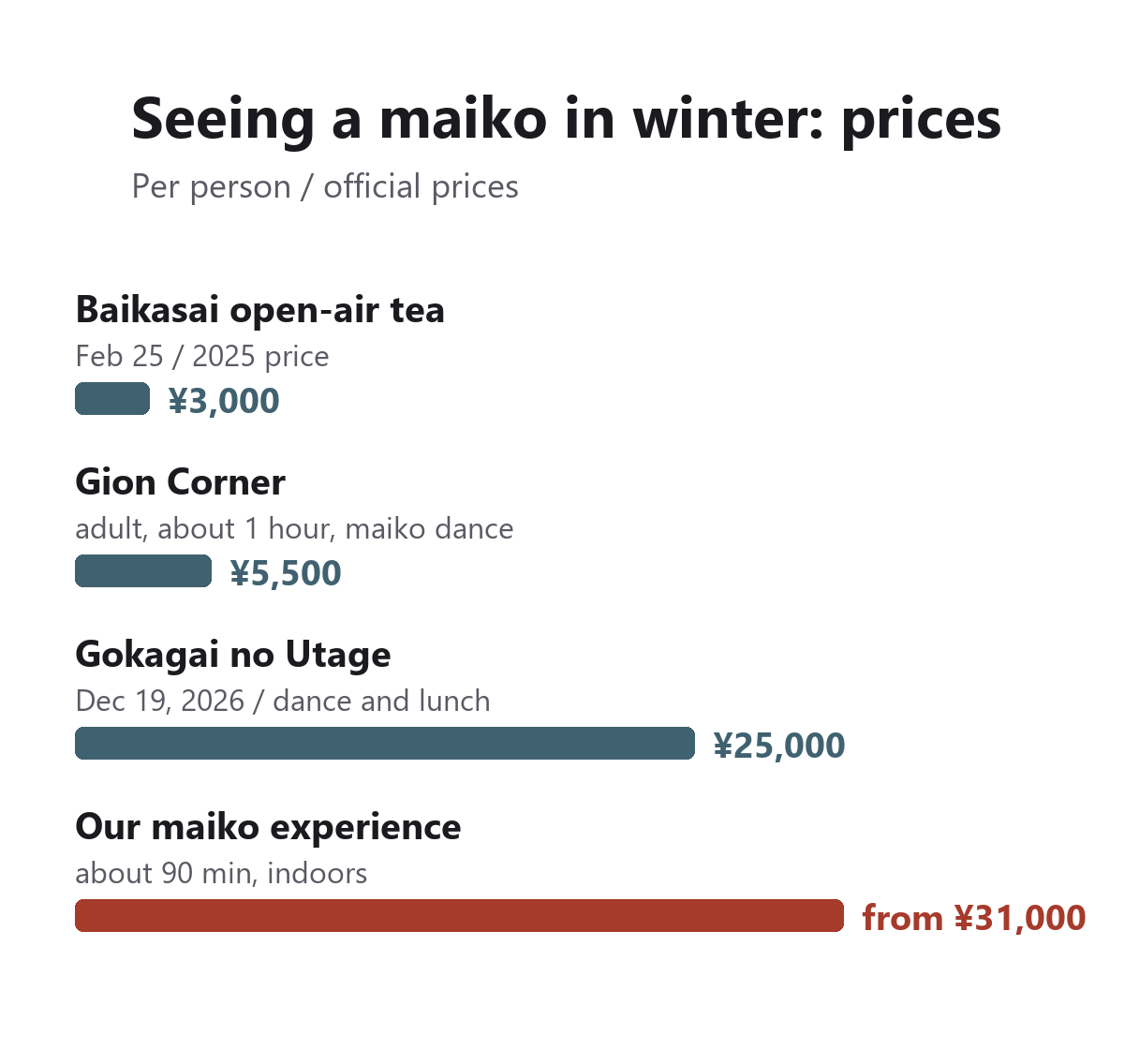
Gion Corner. A small theater in Gion that shows seven traditional arts in about an hour, including a maiko’s dance. Adult tickets are ¥5,500. You watch from a seat. Check the official site for winter performance dates.
Our maiko experience. In about 90 minutes, a maiko dances for your group, plays ozashiki games with you (traditional party games played with geiko and maiko) and joins you for photos. The games are konpira fune fune and tosenkyo. It takes place at Koun-ji, a Zen temple belonging to Nanzen-ji, in a space usually closed to visitors. Its garden is a Place of Scenic Beauty designated by Kyoto City. Groups are about 10 people, and a native English-speaking host interprets throughout, so you can ask the maiko your own questions. You can take photos in the garden on days when it’s possible.
Koun-ji also opens to the public from November 28 to December 6, 2026, as part of Kyoto’s special opening of cultural properties that are usually closed.
A maiko dances, plays traditional games with you and answers your questions, with English interpretation throughout.
Please don’t follow maiko in the street
In winter you may see a maiko in Gion on her way to work or to the year-end greetings. These are working days for her. The Ookini Foundation makes this request in its list of annual events. “Please refrain from taking photos on public streets, as it causes trouble for residents and passers-by.”
In Gion, a local residents’ council has also put up signs on private lanes that ban photos and entry. Watching from a distance is fine. Stopping a maiko, touching her or following her for a photo is not.
Before you book: price, time, clothes and children
- Price: Our 90-minute experience starts at ¥31,000 per person. See pricing for what’s included.
- Cancellation: See our terms and cancellation policy before you book.
- Tea and food: The temple experience doesn’t include matcha or a meal.
- When to book: Winter is quieter than spring and autumn, but groups are small, so book early for the dates you want.
Frequently asked questions
What is there to do in Kyoto in winter?
In the geisha districts, look for the Kencha-sai tea (December 1) and Gokagai no Utage (December 19, 2026). In February, there are the Setsubun dance offerings and the Baikasai open-air tea (February 25). On other days, Gion Corner and our maiko experience take place indoors.
Can you see maiko in Kyoto in winter?
Yes. Maiko work through the winter, and the spring dances start in March. Most winter events in the geisha districts, like Kotohajime and Shigyoshiki, aren’t public. For a set time with a maiko, book a performance or an experience.
Is Kyoto crowded in December and January?
Less than in spring and autumn. In 2025, January and December were among the three months with the fewest foreign overnight stays in Kyoto City. February had the fewest.
What can I do in Kyoto on a rainy day?
Choose something indoors. In the geisha district, Gion Corner shows a maiko’s dance in a theater, and our maiko experience takes place in a temple space.
Do I need to book winter events in advance?
For the Gokagai no Utage, yes: online booking closes on December 4, 2026. The Baikasai tea tickets were sold only at the shrine on the day in 2025. Miyako Odori tickets for April 2027 go on sale on January 6.
Maiko dance, ozashiki games and photos in a temple space usually closed to visitors.