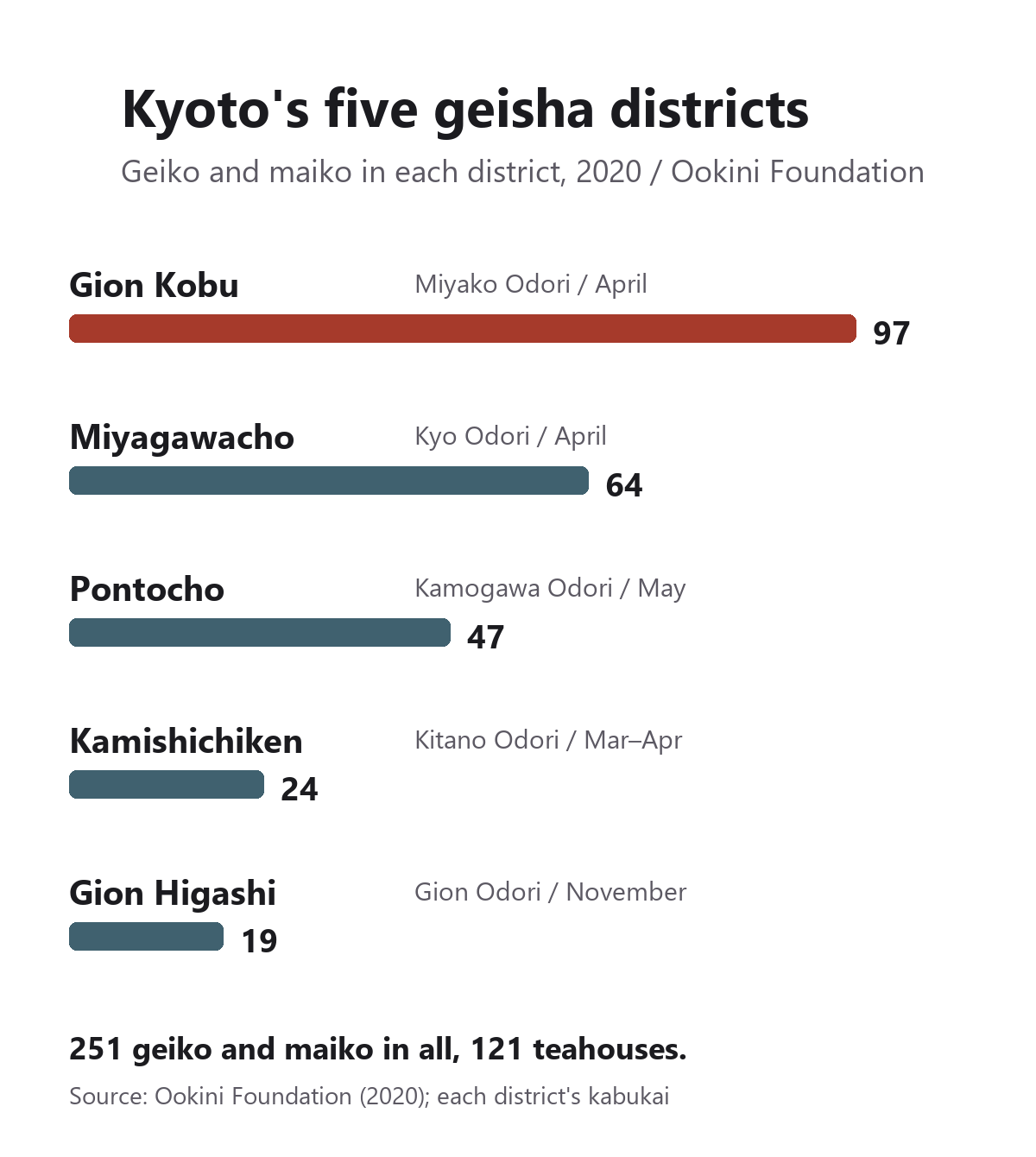
Kyoto’s geisha work in five districts: Gion Kobu, Miyagawacho, Pontocho, Kamishichiken and Gion Higashi. In 2020, the five had 251 geiko and maiko in all. You can see them on stage at the seasonal dances and Gion Corner, or meet a maiko at a small-group experience. Teahouse banquets need an introduction.
| District | Geiko and maiko (2020) | Its dance |
|---|---|---|
| Gion Kobu | 97 | Miyako Odori, April |
| Miyagawacho | 64 | Kyo Odori, April |
| Pontocho | 47 | Kamogawa Odori, May |
| Kamishichiken | 24 | Kitano Odori, March–April |
| Gion Higashi | 19 | Gion Odori, November |
- Geiko and maiko: Kyoto’s words for geisha
- The five geisha districts
- How to see a geiko or maiko
- Why few visitors actually meet one
- Visiting Gion
If you want to sit with a maiko, our 90-minute maiko experience runs on any open date.
Geiko and maiko: Kyoto’s words for geisha
In Kyoto, a geisha is called a geiko. A maiko is an apprentice. The word “maiko” is used only in Kyoto; in other geisha districts in Japan, apprentices are called hangyoku.
A maiko trains for about a year after junior high school, then makes her debut. Around the age of 20, she becomes a geiko. A maiko does her hair using her own hair, while a geiko wears a wig. Our guide to maiko vs geisha explains the differences in detail.
The five geisha districts
Kyoto’s five geisha districts are called the gokagai, the “five flower towns”. Each has its own teahouses (ochaya), its own stage, and its own dance festival.
The histories below come from Kyoto City and the districts’ own Japanese sites. Most of them have not been published in English before.
Gion Kobu
The largest district, with 97 geiko and maiko in 2020. Its dance, the Miyako Odori, runs through April. The 2027 run is April 1–30, with tickets from ¥5,000 to ¥8,000. Gion Corner, a small theater where visitors can watch a maiko’s dance year-round, is in the same building as the district’s stage.
Miyagawacho
South of Gion. Its teahouse association has 27 member teahouses. At its spring dance, the Kyo Odori, every ticket includes tea, and a geiko makes the tea while you sit at a table.
Pontocho
A narrow lane between the Kamo River and the Takase River. According to Kyoto City, river works in 1670 created a strip of land here, and five houses were built on it in 1674. The district received official permission for geiko in 1813. Its dance, the Kamogawa Odori, was first held in 1872.
Kamishichiken
The oldest story belongs to Kamishichiken, in the north near Kitano Tenmangu shrine. The district tells this story: in 1587, at a great tea ceremony held at Kitano, its seven teahouses served as a resting place for the warlord Toyotomi Hideyoshi. They offered him rice dumplings (mitarashi dango). The five dumplings in its crest come from that story. Its theater was built in 1895.
Gion Higashi
The smallest district, with 19 geiko and maiko in 2020. In 1881, the governor of Kyoto split Gion into two associations, and Gion Higashi became one of them. Its crest, a row of connected dumplings, shares its origin with Gion Kobu’s. The Gion Odori in early November is the only odori held in autumn.
Show answer
How to see a geiko or maiko
| If you want to… | Do this | Our guide |
|---|---|---|
| Watch the dancing | A seasonal odori, Gion Corner or the museum dance | Geisha shows in Kyoto |
| Talk with a maiko | A small-group experience | Geisha experience in Kyoto |
| Eat while they perform | Gokagai no Utage (December) or Gokagai no Yube (June) | Geisha dinner in Kyoto |
| Have tea served by geiko | An odori tea seat | Geisha tea ceremony in Kyoto |
| Walk the districts with a guide | A Gion walking tour | Kyoto geisha tour |
| Compare every option by price | See the price guide | How much does a geisha cost? |
A traditional teahouse banquet needs an introduction from a regular guest. Teahouses don’t publish prices.
A maiko dances, plays traditional games with you and answers your questions, with English interpretation. Groups are about 10 guests.
Why few visitors actually meet one
Kyoto City’s 2025 survey of foreign visitors shows a large gap between seeing Gion and experiencing its culture.
Gion Corner had 76,894 visitors that year, and about nine in ten were from abroad. Most visitors walk through Gion, but only a few see a geiko or maiko perform, and fewer still talk with one.
Visiting Gion
You may see geiko and maiko in Gion on their way to work. They aren’t performing for visitors. The local residents’ council asks visitors not to stop, touch, follow or photograph them without permission, and some lanes are private roads where photos are banned.
- Kyoto City has placed manner wardens on Hanamikoji Street since autumn 2023, and all year since autumn 2026.
- If you want photos with a maiko, choose an experience where photos are part of the program.
Our guide to the Kyoto geisha tour covers Gion’s street rules in detail.
▶
◀
Frequently asked questions
Can you see geisha in Kyoto?
Yes. Kyoto has five geisha districts with about 250 geiko and maiko (2020). You can see them on stage at the seasonal odori and Gion Corner, or meet a maiko at a small-group experience.
Where can I see geisha in Kyoto?
On stage: Gion Corner and the Gion Kagai Art Museum in Gion, and each district’s odori. In person: a small-group maiko experience, or a meal event such as Gokagai no Utage.
What is the geisha district of Kyoto?
There are five: Gion Kobu, Miyagawacho, Pontocho, Kamishichiken and Gion Higashi. Gion Kobu is the largest.
What is a geiko?
Geiko is the Kyoto word for geisha. An apprentice geiko is called a maiko.
What is the best time to see geisha in Kyoto?
Spring, when four of the five districts hold their dances (March to May). In November, Gion Higashi holds the Gion Odori. Gion Corner runs most of the year.
A maiko dances, plays ozashiki games with you and joins you for photos, in a temple space usually closed to visitors.