Konpira fune fune is a party game that geisha play with their guests. Two players sit face to face and take turns touching a small object between them, in time to a song. When one player picks the object up, the other must put down a fist instead of an open hand. The song gets faster, and the first to use the wrong hand loses.
| Players | Two, face to face |
| What you need | A small sake-flask holder (hakama), a song, often a shamisen |
| How you lose | Use the wrong hand shape |
| Where it comes from | Kotohira, Kagawa Prefecture, according to local news |
| Where to play it in Kyoto | With a maiko at a geisha experience |
- How to play, step by step
- Where the game comes from
- The song
- Play it with a maiko in Kyoto
How to play, step by step
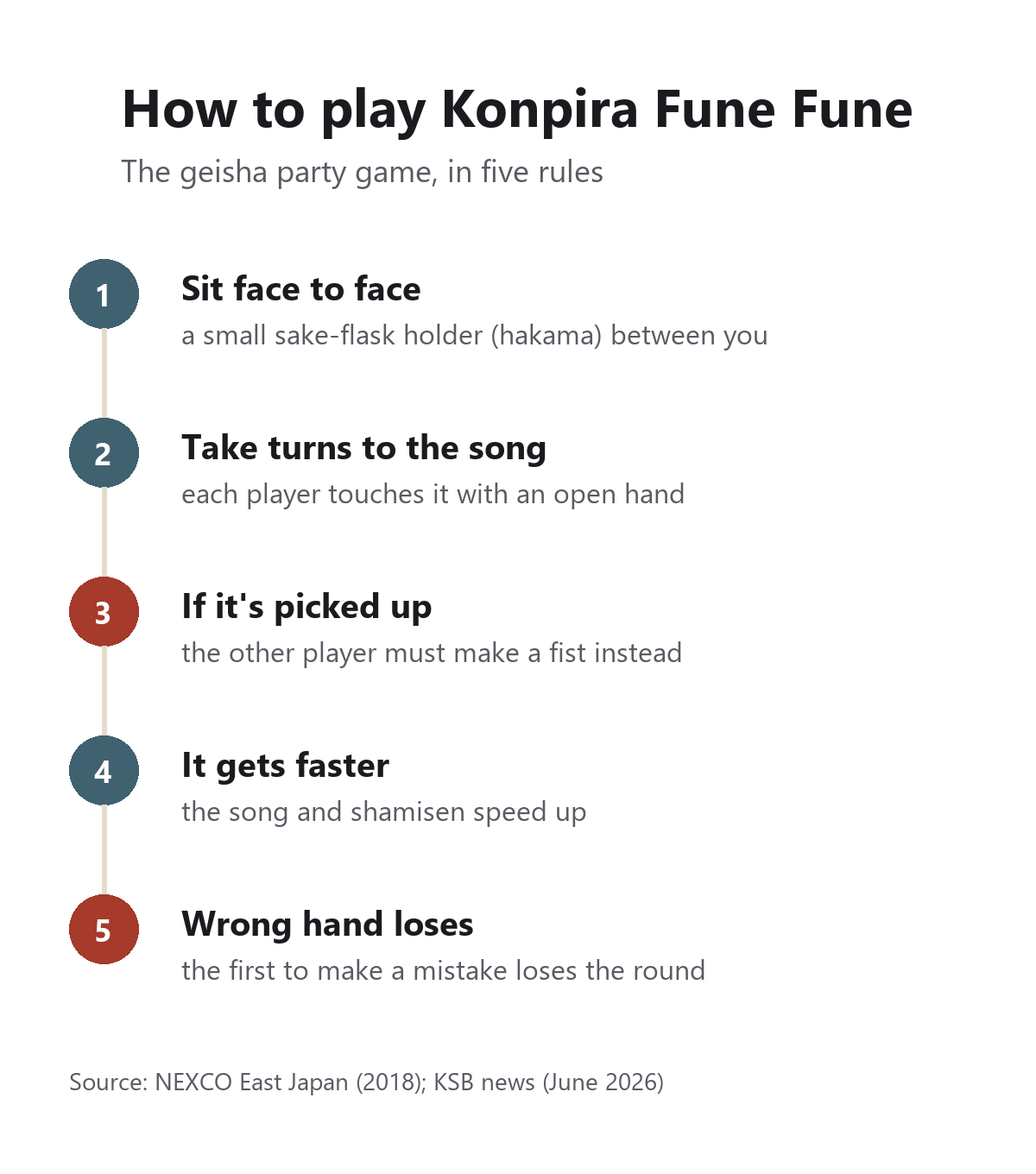
These rules come from two Japanese sources. One is a 2018 feature by NEXCO East Japan, in which a geisha taught the game to guests at a banquet. The other is a 2026 local TV news report on a konpira fune fune tournament. Neither has been published in English, so we translated the main points.
It sounds simple, and that’s the trap. One player at the 2026 tournament said that the rules are very simple, but once the tempo goes up, it takes everything just to keep up.
In the banquet described by NEXCO East Japan, the loser drank a “penalty cup” (bappai) of sake, then struck a pose to the shamisen. That was one banquet, and other rooms may do it differently.
Show answer
Where the game comes from
According to KSB, a local TV station in Kagawa Prefecture, konpira fune fune is a banquet game from the town of Kotohira that has been played since the Edo period. Kotohira is home to Kotohira-gu shrine, known as Konpira-san. Japan’s tourism agency says that by the 18th century, the shrine drew pilgrims from all over Japan, and the town around it grew with them.
In June 2026, a Kotohira tourism association held the first konpira fune fune tournament in the town where the game began, and seven teams came from inside and outside Kagawa.
The song
The game is played to a folk song of the same name, which takes its name from Konpira. We don’t print the lyrics here. Both of our sources describe it with a shamisen: in the banquet NEXCO East Japan described, the geisha sang the song and played the shamisen herself while the guests played.
Kyoto City lists konpira fune fune as one of the typical ozashiki asobi, the party games of the geisha districts. The others it names are tora tora, a rock-paper-scissors game, and tosenkyo, a fan-throwing game.
Play it with a maiko in Kyoto
You don’t need a teahouse introduction to play. At our 90-minute experience at Koun-ji, a Zen temple in Kyoto, a maiko plays konpira fune fune and tosenkyo with your group. She speaks Japanese, and a native English-speaking host explains the rules and interprets as you play.
The experience doesn’t include sake, so there’s no penalty cup.
A maiko dances, plays konpira fune fune and tosenkyo with your group, and answers your questions. Groups are about 10 guests.
▶
◀
Frequently asked questions
How do you play the Japanese geisha game konpira fune fune?
Two players sit face to face and take turns placing a hand on a small sake-flask holder (hakama) to the song. If one player lifts the hakama, the other must put down a fist. The song speeds up, and the first to use the wrong hand loses.
What is the hakama in konpira fune fune?
A small holder that sits under a sake flask. It’s already in the banquet room, which is why the game needs no special equipment.
What song do geisha sing when playing?
For this game, the folk song “Konpira Fune Fune”, played with a shamisen in the sources we found. The song is named after Konpira, the popular name of Kotohira-gu shrine.
Where does konpira fune fune come from?
According to local news, it’s a banquet game from Kotohira in Kagawa Prefecture, played since the Edo period.
Can I play konpira fune fune in Kyoto?
Yes. At our maiko experience, a maiko plays konpira fune fune and tosenkyo with your group, with English interpretation.
A maiko dances, plays konpira fune fune and tosenkyo with you, and joins you for photos, at Koun-ji temple.