There are five main ways to see geisha perform in Kyoto. They range from a 15-minute dance in a museum for ¥1,600 to a private evening in a teahouse that you can only enter by introduction. The right choice depends on three things: how close you want to be, your budget, and the month you visit.
In Kyoto, geisha are called geiko, and apprentices are called maiko. This guide uses “geisha” for both, the way most travelers search for them. Our maiko vs geisha guide explains how to tell them apart.
| Option | How close you get | Price (adult) | When |
|---|---|---|---|
| Seasonal odori (dance festivals) | Theater seat | ¥4,000–¥8,000 | Mostly March–May, plus November |
| Gion Corner | Theater seat | ¥5,500 | Year-round |
| Museum dance (Gion Kagai Art Museum) | Small room, up to 60 people | ¥1,600 + ¥1,500 admission | Year-round, with breaks |
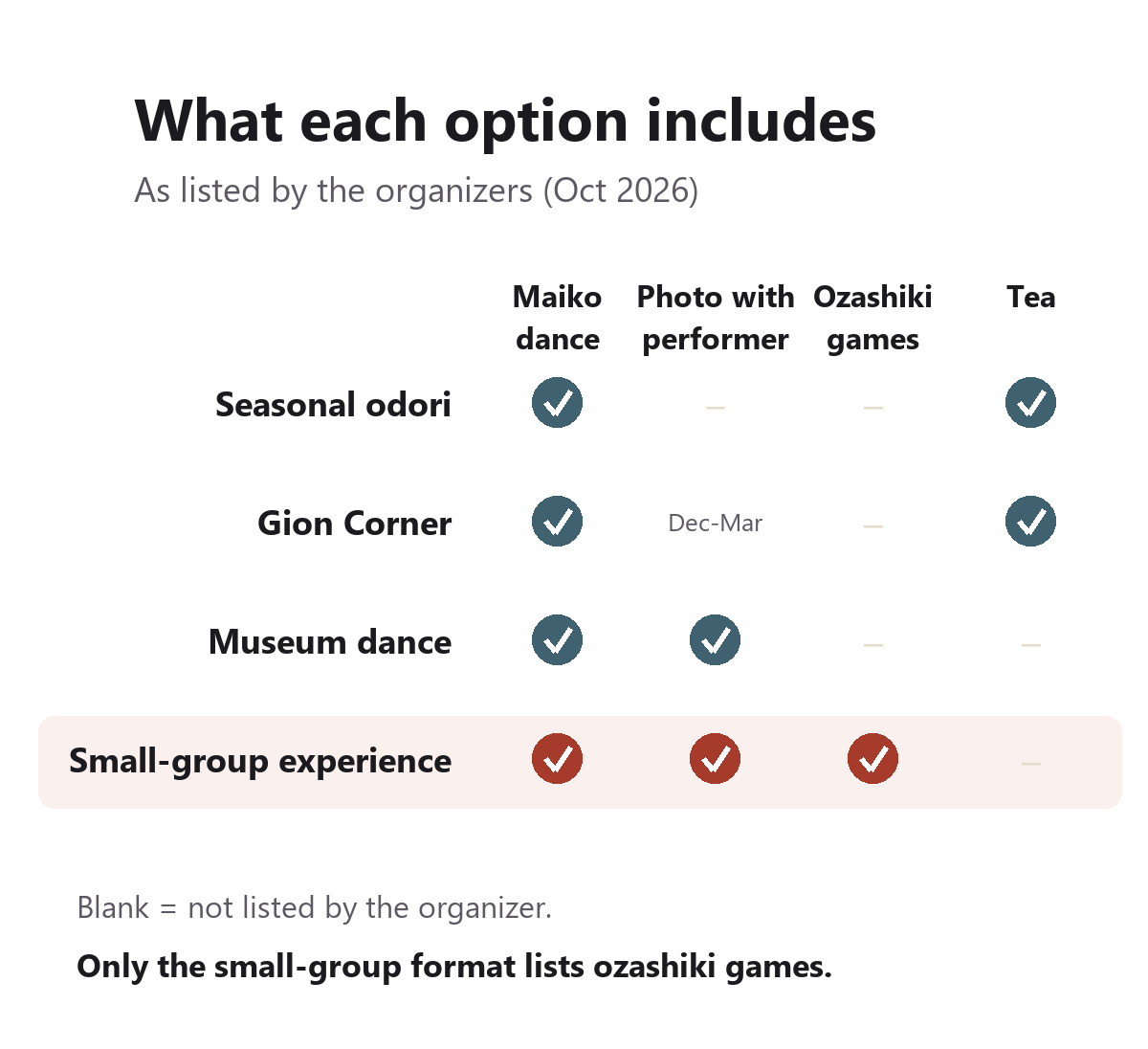
| Small-group maiko experience | Same room, games and photos | from ¥31,000 | Year-round |
| Private ochaya banquet | Private room | No public price | By introduction only |
- The five ways to see geisha perform, compared side by side
- 2026–2027 dates and ticket prices from the official sites
- Why most teahouses won’t take first-time guests, and what to do instead
- Gion’s photo and etiquette rules, in the locals’ own words
If you want to sit with a maiko, talk with her through an interpreter and play the traditional party games, a small-group experience is the most direct way. See our 90-minute plan.
1. Seasonal odori: Kyoto’s big dance festivals
Each of Kyoto’s five geisha districts (hanamachi) holds its own public dance festival, called an odori. Geiko and maiko perform together on stage, and a show lasts about an hour to an hour and a half. It is the best way to see the dancing at its most polished.
The five districts are Gion Kobu, Miyagawacho, Pontocho, Kamishichiken and Gion Higashi.

| Odori | District | 2026 dates | Tickets |
|---|---|---|---|
| Kitano Odori | Kamishichiken | Mar 20 – Apr 2 | ¥6,000 / ¥7,000 with tea |
| Miyako Odori | Gion Kobu | Apr 1 – 30 | 2027: ¥5,000–¥7,000 / ¥8,000 with tea |
| Kyo Odori | Miyagawacho | Apr 4 – 19 | ¥6,000 / ¥7,000 (tea included) |
| Kamogawa Odori | Pontocho | May 5 – 22 | ¥4,000–¥6,000 / ¥7,000 with tea |
| Gion Odori | Gion Higashi | Nov 1 – 10 | ¥6,000 / ¥7,000 with tea |
A few details that are easy to miss on the official sites:
- Miyako Odori goes up in price in 2027. The 2027 run is April 1–30, with three shows a day at 12:30, 14:30 and 16:30. Tickets go on sale on January 6, 2027, and the organizer does not accept cancellations or refunds.
- What the tea ticket adds. Before the show, you are served tea and a sweet. At Miyako Odori and Kamogawa Odori, you can take the small sweets plate home.
- Check the age limits. Kyo Odori does not admit children under 10. Gion Odori does not admit children under 3.
- Gion Odori is the only odori in autumn. If you visit in November, this is your chance.
In June, the five districts perform together at Minamiza theater in Miyako no Nigiwai. In 2026 it ran on June 27–28 with about 70 geiko and maiko, and tickets started at ¥6,500. Each district also holds an autumn recital. In 2026, Gion Kobu’s Onshukai runs October 1–6, Miyagawacho’s Mizue-kai October 8–11, and Kamishichiken’s Kotobukikai November 12–18, with tickets from ¥6,000 to ¥10,000.
▶
◀
▶
◀
2. Gion Corner: a one-hour sampler of Japanese arts
Gion Corner is a small theater inside the Gion Kobu Kaburenjo, run by the Kyoto Traditional Musical Art Foundation. In about an hour, you see a maiko perform Kyoto-style dance (kyomai). The show also has short demonstrations of tea ceremony, flower arranging, koto music, bugaku court dance and kyogen comedy. Depending on the season, bunraku puppetry or noh is also included.
Adult tickets cost ¥5,500. A premium seat is ¥6,600, and a seat that includes the tea ceremony costs ¥6,050. It runs year-round, so it is a good fallback when no odori is on. In winter, the program ends with a commemorative photo with the maiko.
3. The museum dance: 15 minutes, up close
The Gion Kagai Art Museum, on Hanamikoji Street, holds a short dance performance most afternoons. One geiko or maiko performs two pieces of Inoue-school kyomai in about 15 minutes, for up to 60 people. The ticket is ¥1,600, plus the museum admission of ¥1,500.
You cannot photograph or film the dance. After some shows, there is a commemorative photo session for ¥2,000 per group (up to five people), sold on the day only. The museum pauses performances at times, so check the official site before you go.
4. Ochaya banquets: why most travelers can’t book one
A private banquet in a teahouse (ochaya) is the traditional way to spend an evening with geiko and maiko. It is also the hardest to arrange. Kyoto’s ochaya follow a custom called ichigen-san okotowari: they do not accept first-time guests without an introduction.
Kyoto City describes this as a business practice: by knowing their guests, the teahouses can offer a higher level of hospitality.
There is one official route. The Kyoto Traditional Musical Art Foundation runs a supporters’ club, and an introduction to an ochaya is one of its member benefits. The annual fee is ¥38,000, or ¥20,000 if you only want the introduction.
For most travelers on a short trip, the realistic way to sit in the same room as a maiko is a bookable small-group experience.
Our 90-minute experience takes place in a temple space that is usually closed to visitors. A maiko dances, plays ozashiki games with you and poses for photos, and our staff interpret everything into English.
5. Small-group maiko experiences: the closest you can get
At a small-group experience, the maiko comes to you. You share a room with her, watch her dance and play ozashiki asobi, the drinking-party games geiko and maiko play with their guests. Then you take photos together.
Not sure whether you want to meet a maiko or dress up as one? Our guide to the maiko experience in Kyoto explains the difference.
Here is how our own plan works, so you know exactly what you are booking:
The experience lasts about 90 minutes and costs from ¥31,000 per person. The final price depends on the date, venue, number of guests and the maiko’s availability, and it is confirmed before your booking is finalized. A dinner plan with a multi-course Kyoto meal is in preparation (coming soon).
▶
◀
▶
◀
Which geisha show is best for you?

| If you want… | Choose |
|---|---|
| To see the dancing at its finest | A seasonal odori (spring, or Gion Odori in November) |
| A cheap first look, any time of year | The museum dance or Gion Corner |
| To talk with a maiko and take photos together | A small-group experience |
| A traditional teahouse evening | An ochaya banquet, if you have an introduction |
Show answer
Etiquette in Gion: what the locals ask
You may see geiko and maiko walking through Gion on their way to work. In December 2023, Gion Kobu’s teahouse and geiko associations, Kennin-ji temple and the Gion-machi Minamigawa district council issued a message to visitors. Two lines from it sum it up:
- “This is a place of daily life, not a theme park.”
- “Please do not stop, touch, follow or photograph geiko and maiko without permission as they walk by.”
The same message lists the penalties under existing law. For example, blocking someone’s way or following them can lead to detention or a fine, and entering private property without permission can lead to imprisonment or a fine. Kyoto City has also placed manner wardens on Hanamikoji Street since spring 2026.
If you want photos with a maiko, choose a format that includes them: the museum photo session, Gion Corner in winter, or a small-group experience.
Before you book: practical questions
- Do I need to speak Japanese? Not for our experience. The maiko speaks Japanese, and our staff interpret into English.
- What should I wear? Smart casual. Some venues ask you to take off your shoes, so wear comfortable socks.
- Can children join? For our experience, it depends on the plan and venue, so tell us your children’s ages when you book. For the odori, check each festival’s age limit.
- How early should I book? Early. Maiko, geiko and private venues have limited availability, and odori tickets go on sale months ahead.
- What if my plans change? See our Terms & Cancellation Policy before you book. Miyako Odori tickets cannot be cancelled or refunded.
Frequently asked questions
Where can I see real geisha in Kyoto?
At the five seasonal odori, at Gion Corner, at the Gion Kagai Art Museum’s afternoon dance, at bookable experiences, and at ochaya banquets for guests with an introduction.
How much does it cost to see a geisha in Kyoto?
From ¥3,100 for the museum dance (including admission), ¥4,000–¥8,000 for an odori, ¥5,500 for Gion Corner, and from ¥31,000 per person for our small-group experience. Ochaya banquets do not publish prices.
What is the best time of year to see a geisha show?
Spring. Kitano Odori, Miyako Odori and Kyo Odori run in March and April, and Kamogawa Odori in May. In autumn, there is Gion Odori in November and each district’s autumn recital.
What is the difference between a geiko and a maiko?
In Kyoto, a fully trained geisha is called a geiko. A maiko is an apprentice who is still training in dance and the other arts.
Can I take photos of geisha in Gion?
Not without permission. The local associations ask visitors not to stop, touch, follow or photograph geiko and maiko on the street. Choose an experience that includes a photo session instead.
Maiko dance, ozashiki games and photos in a temple space usually closed to visitors.